
Bureau of Indian Standard [IS-15820]
A hallmark identifies the purity of gold and can be achieved through the BIS system. The BIS outlines two main objectives for the hallmarking scheme and they are as follows:
- To protect the public from adulteration.
- Force manufacturers to meet statutory purity / purity standards
Assaying and Hallmarking center –
Jewelry testing and marking is carried out at accredited testing and contrasting centers across the country. These are private companies that are approved and supervised by the BIS. Gold items are evaluated and tested here and the metal used is then certified to meet national and international standards for fineness and purity.Types of marks on gold jewelry :-
As part of the BIS Act, the stamp agency certifies gold according to Indian standards. Gold jewelry must be evaluated and tested in official contrasting centers and then certified that the metal meets national and international standards for fineness and purity.
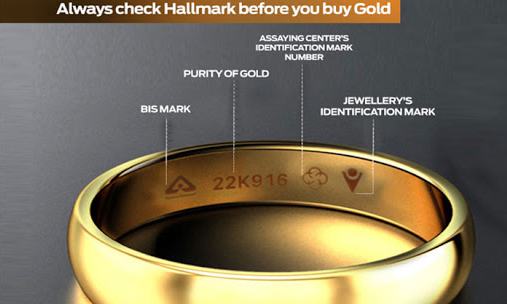

Hallmark consists of five components i.e.
(1.) BIS Standard Mark
This mark certifies that the product complies with a series of standards set by the Bureau of Standards of India.
(2.) Purity Grade
The purity of the gold indicates how pure the gold is. It is displayed in two ways: karat (referred to as KT) and fineness.
- 999 – 24 carat – Pure Gold
- 916 – 22 carat
- 750 – 18 carat
- 585 – 14 carat
- 333 – 8 carat
| Karat Hallmark | |||
|---|---|---|---|
| Karat Measure | Traditional Hallmark | Modern Hallmark | Gold Purity |
| 24 Karat | - | - | 100% |
| 22 Karat | 916 | 22K | 91.6% |
| 18 Karat | 750 | 18K | 75% |
| 14 Karat | 585 | 14K | 58.5% |
| 10 Karat | 417 | 10 | 41.7% |
(3) Assaying and Hallmarking Center's Mark
This mark is a code used to identify the testing and contrasted center that marked the jewelry according to BIS guidelines. It is important to note that jewelry is stamped by BIS approved centers and not by jewelers.
4) Year of Marking
The alphabets represent the jewelry hallmark year and are donated by BIS, eg letter "A" for 2000, "J" for 2008, "N" for 2010, "M" for 2011 and "N" for 2012. , etc.
(5) Jeweler's Identification Mark
Many jewelers selling the product maintain their own distinctive brand from a BIS certified jeweler / jewelry maker. It may also contain the jeweler's logo.
PROCEDURE FOR SETTING HALLMARKING AND ASSAYING CENTER
According to the Indian standard 15820: 2009 for the creation of an analysis and contrast center, the company or the individual must follow certain steps:
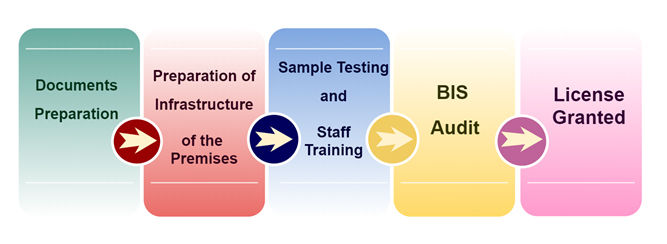
Step 1- DOCUMENTS PREPRATION
-
(i) Documents must be prepared for the presentation of the project to the BIS.
-
(ii) The required documents were mentioned separately.
Step 2- PREPRATION OF THE INFRASTRUCTURE OF THE PREMISES
-
The premises must be at least 550 square meters. feet to 650 square feet to be tall.
-
The premises must have a 15 kVA generator as an emergency power source.
-
There must be an air-conditioned center with security measures such as CCTV, LOCKERS, etc.
-
The reception, the quality manager's office, the XRF area, the laser area, the sampling area, and the testing laboratory need to be set up separately.
-
The platform of the microbalance must be resistant to vibrations.
Step 3- SAMPLE TESTING AND STAFF TAINIG
-
Includes sending CRM samples for testing. The required sample quantity is AV 2KG, AG 5G, CV 50G, PB 50G.
-
Our manager trains facility personnel according to BIS standards.
Step 4- BIS AUDIT
-
Representatives of the BIS are appointed to audit the facilities and laboratories of the centers.
Step 5- LICENCE GRANTED
-
After the successful examination and examination of the documents, approval is given for the certification of the center.
 B1/H3, MOHAN CO-OPERATIVE INDUSTRIAL Mathura Road, 91 Springboard, behind Audi Showroom, New Delhi, Delhi 110044
 +91 9324094697 , 9210604707
 support@accredify.in / sid@accredify.in